











How to Make Passive Income: 15+ Examples and Ideas
 Phil Town
 Passive income examples fall into three broad buckets: money your investments earn, money your property earns, and money your knowledge or creations earn. It can change your financial life, but first, let's be honest about what it actually takes. I'll walk you through more than fifteen real examples of passive income, and I'll be honest about what each one can and can't do for you. Some are worth your time. A few come with catches most lists never mention.
How to Pick Rule #1 Stocks
5 simple steps to find, evaluate, and invest in wonderful companies.
What is Passive Income?
Simply put, passive income is money that you earn easily. It doesn’t require a large amount of ongoing effort to maintain these additional revenue streams.
And, that’s what we love to hear.
Though this is great, it’s important to keep in mind that most passive income ideas require you to invest money, time, or resources in order to get started. Once you make the decision to begin, though, you and your wallet will reap the benefits of these investments.
Passive Income vs. a Side Hustle
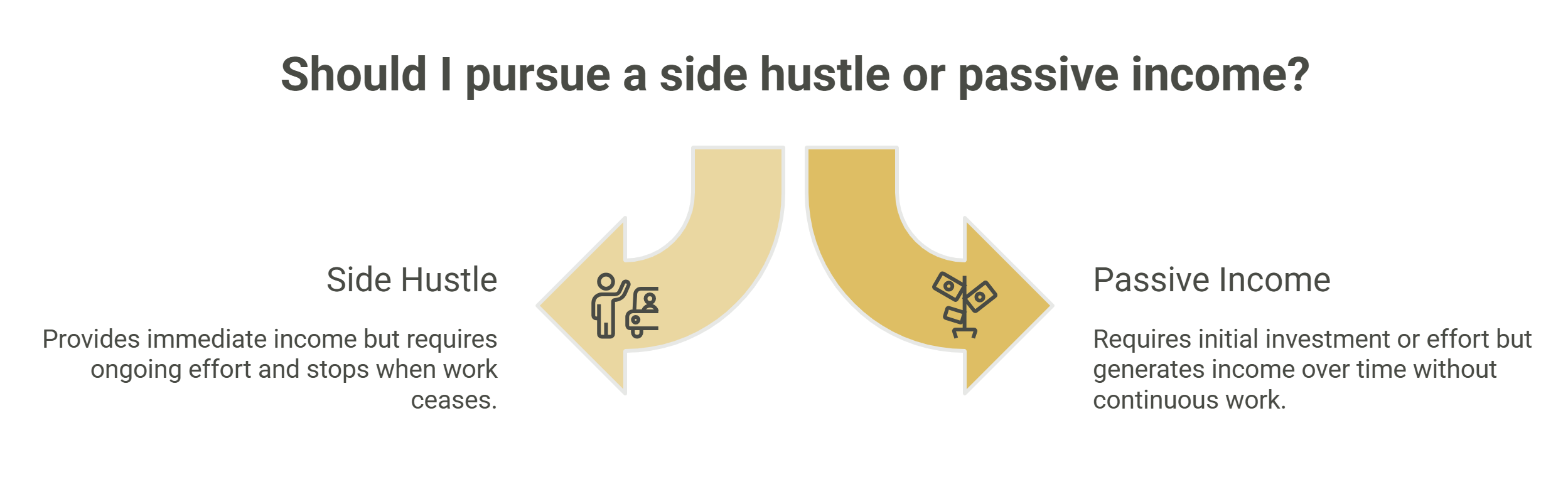
People use "passive income" and "side hustle" as if they mean the same thing. They don't.
A side hustle is active income wearing a different hat. You drive the rideshare, you take the freelance job, you work the weekend shift, and the money comes in only while you're working. Stop working and the income stops. That's not passive. That's a second job.
A passive asset works differently. You put in the effort or the capital once, and the asset keeps producing after you step away. The course still sells. The company still earns. The rent still shows up. That's the whole point.
I'm not against hard work. I dug ditches and guided boats through the Grand Canyon for years. But the goal isn't to work forever. The goal is to build assets that eventually do the earning for you, and to do it without losing money along the way. Rule #1 investing has always been about that first principle: don't lose money. Every example below gets measured against it.
The Three Categories of Passive Income
Almost every passive income idea worth pursuing lands in one of three categories.
The first is investment-based income. This is money that comes from putting capital to work, through savings interest, stock ownership, dividends, and the like. It usually asks for money up front and very little time after that.
The second is real estate income. This comes from property you own or space you control, whether that's a rental home, a room, or a parking spot. It tends to ask for both capital and some ongoing management.
The third is business and creator income. This is money your knowledge or creations earn, through courses, digital products, blogs, and affiliate marketing. It's usually the reverse of investing. It asks for a lot of time and skill up front, and very little money.
None of these is "the best" for everyone. The right mix depends on how much capital you have, how much time you can give, and what you actually understand. Let's walk through the examples.

Investment-Based Passive Income
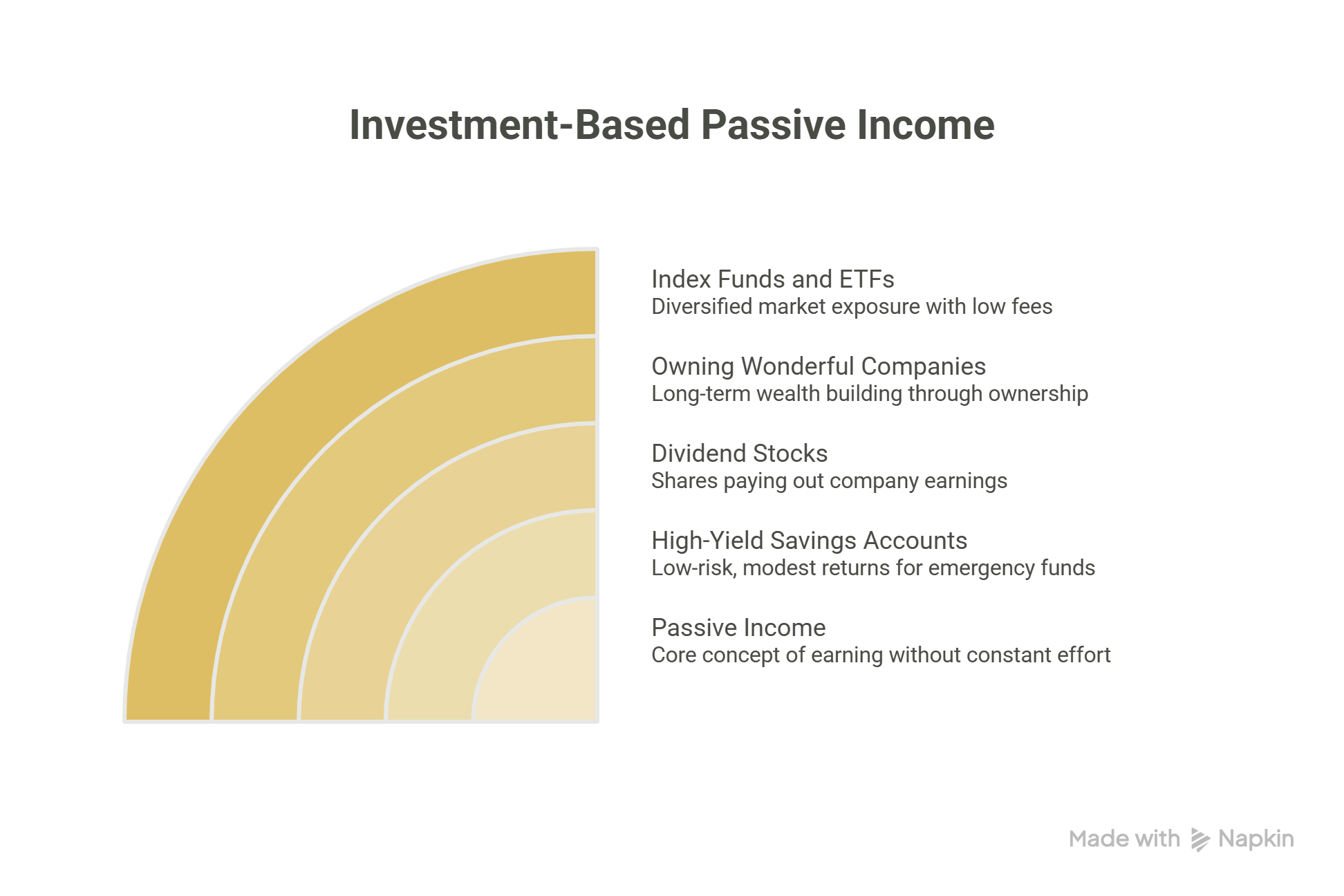
These are the passive assets I know best, and the ones I'd point most people toward first. They ask for capital rather than constant effort, and the good ones compound quietly for decades.
1. High-Yield Savings Accounts
Money in a savings account earns interest, which means you get paid a little just for keeping cash where it is. A high-yield savings account, federally insured and typically paying several times the national average, often in the 3.5% to 4.5% range depending on the bank, lets you earn meaningfully more on that same cash. Rates move with the Fed and the broader market, so it's worth checking current numbers before you park a large sum.
This is about as low-effort as passive income gets, and it's the right home for your emergency fund and short-term savings. Just know its limits.
Interest on cash is a modest return by design, and over long stretches it tends to trail inflation. That makes savings a safe place to hold money, not a strong place to grow it.
For growth, you want an asset that can compound faster than cash sitting still, which brings us to the power of compound interest working inside a business.
2. Dividend Stocks
Dividends are cash payments a company makes to its shareholders out of its earnings. The board of directors decides how much to pay and when, and for many investors those payments are an appealing source of passive income. Own the shares, collect the dividend, repeat.
As Rulers, we think about dividends a little differently. We treat a dividend as a return of capital rather than just a yield percentage, because each payment lowers our cost basis in the business. When your basis goes down, so does your risk, and lowering risk is always the goal.
Here's how Rule #1 investors think about dividends: the yield only matters if the underlying business is a wonderful company bought at a fair price. A fat dividend from a mediocre company is usually a warning sign, not a bargain. The dividends worth holding are the ones backed by real earnings from a company with a durable Moat.
3. Owning Wonderful Companies
Buying shares of an individual company is one of my favorite ways to build passive income, because when you own a piece of a great business, you own a piece of everything it earns. The company does the work. You own the asset. That's ownership, and ownership is how real wealth gets built.
The trick is knowing which businesses to own, and that's where the Four Ms come in: Meaning, Moat, Management, and Margin of Safety. Meaning asks whether I understand the business and whether it sits inside my Circle of Competence. Moat asks whether it has a durable advantage. Management asks whether honest people run it. Margin of Safety asks whether I can buy it well below what it's actually worth.
When all four answers are yes, I'm not gambling. I'm buying a wonderful business at an attractive price, then letting it compound.
If you want the full method, here's the Rule #1 way to generate passive income through investing.
4. Index Funds and ETFs
Index funds and exchange-traded funds show up on nearly every passive income list, and I understand why. They're simple, they carry low fees, and you can buy a broad slice of the market with one click. If you don't want to learn to evaluate businesses, a broad-market fund is a reasonable place to start.
Here's my honest counterpoint, though. An index gives you the average of every company in it, the strong ones and the weak ones together. That means you can't calculate a Margin of Safety or an expected return the way you can with a single business you understand. You're buying the whole basket at whatever price the market sets that day.
The market average becomes your ceiling. That's not nothing, but it's a very different outcome than owning a handful of wonderful companies you bought on sale. I'd rather understand exactly what I own than settle for the average.
5. Bonds
A bond is a loan. When you buy a government or corporate bond, you're lending your money in exchange for a fixed rate of interest over a set period. Those interest payments are a steady, predictable form of passive income, which is why bonds get recommended so often for people who want stability.
But here's what that fixed rate really means. The day you buy the bond, your return is locked in, and it doesn't matter if the company you lent to goes on to have its best decade ever. You have no ownership stake and no share in that growth. You're a lender, and lenders don't participate in the upside.
Bonds serve a purpose for someone who needs predictable income or wants to protect capital for a while. For building long-term wealth, though, a fixed return with a built-in ceiling won't get you there. That's the tradeoff of being a lender instead of an owner.
6. Real Estate Investment Trusts (REITs)
A REIT lets you invest in real estate without owning property directly. These trusts own income-producing real estate, from warehouses to apartments, and they pay you dividends from the rent and profits. Because REITs trade like stocks, they're far more liquid than a building, and you can sell out of one in seconds rather than months.
That tradability is a real advantage, and it means you can bring some Rule #1 thinking to the table. You can study the management team, assess the quality of the underlying properties, and even work toward a Sticker Price the same way you would for any public company. That makes a REIT more evaluable than a single piece of property.
The one thing to watch is the Moat. Real estate portfolios vary widely in quality and location, so some REITs have durable advantages and many don't. Do the research before you buy, and treat it like any stock: know what you own and what it's worth.
7. Peer-to-Peer Lending
Peer-to-peer lending platforms let you lend money directly to individuals or small businesses and collect interest as they repay. On paper it's tidy passive income, and the advertised rates often look better than a savings account. That's the appeal.
The catch is default risk, and it's real. When a borrower stops paying, your return can shrink fast, and spreading your money across many loans only softens the blow rather than removing it. You're taking on the risk of a lender without the protections a bank has built over a century of doing this.
My honest take is the same one I apply everywhere. Owning a wonderful company means I can actually calculate what I'm buying and what I expect to earn. With peer-to-peer lending, you're betting on strangers you can't evaluate. That's not a foundation to build real wealth on.
Real Estate Passive Income
Property is one of the oldest passive assets there is, and people trust it because they can see it and touch it. It usually asks for more capital and more management than investing, but done right, it can pay you for a long time.
8. Long-Term Rental Property
The classic real estate play is buying a home or building and renting it to tenants who pay you every month. That rent is passive income, and over time the property itself may appreciate too. Being a landlord is more hands-on than most items on this list, since you're responsible for upkeep, repairs, and the tenants themselves.
Here's how I approach real estate as a Rule #1 investor: I look at a piece of property the same way I look at a business. I want to know what it's actually worth, and I want to buy it at a Margin of Safety, well below that value.
Years ago I bought raw land in Iowa for far less than similar developed land was selling for, improved it, and sold it off in parcels. It worked because of that gap between price and value. Hoping for appreciation is not a strategy. Buying a passive asset at a discount to its real worth is.
9. Short-Term and Vacation Rentals
Short-term rentals are the newer cousin of the long-term lease. Instead of one tenant on a year-long agreement, you rent to travelers for a few nights at a time through platforms like Airbnb or Vrbo. In a high-demand area, nightly rates can add up to more than a traditional monthly lease would bring in.
The tradeoff is effort. Short-term rentals need more active management than long-term ones, including cleaning between guests, handling messages, and keeping the calendar full. Some of that you can outsource to a property manager, though every service you hire trims your margin.
Run the numbers the Rule #1 way before you jump in. Know what the property is worth, know what it realistically earns after all those costs, and make sure you've bought with enough cushion that a slow season doesn't sink you. A rental only counts as a passive asset if the math works when the calendar doesn't.
10. Renting Out Space You Already Have
You don't need to buy a second property to earn rental income. You can rent out space you already control. A spare room can bring in a monthly payment, and platforms make it straightforward to find a tenant or a short-stay guest.
The same goes for space you might not think of as valuable. In a crowded city, a secure parking spot is worth real money to someone who can't find one, and you can list an extra spot by the day or the month. Unused storage space works the same way, and a service like Neighbor connects you with people who need somewhere to keep their things.
This is one of the lowest-barrier forms of passive income on this list, because the asset already exists. You're just putting an idle asset to work. The effort is minimal, and the income, while modest, is close to free of upfront cost.
Business and Creator Passive Income
This category flips the investing model on its head. Instead of a lot of money up front, it asks for a lot of skill and effort up front. Build the asset once, and a good one keeps selling long after the work is finished.
11. Online Courses
What are you an expert in? You can turn that knowledge into a passive asset. Build an online course once on a platform like Teachable, Kajabi, or Thinkific, and it can sell again and again with no extra work per sale. You film it once, you price it once, and it pays you repeatedly.
Your knowledge compounds too, which is the part most people miss. The more you teach a subject, the sharper your own understanding gets, and the more valuable every future course becomes. Whether you build a full course or run live sessions, you're creating a genuine passive income opportunity out of what you already know.
How to Pick Rule #1 Stocks
5 simple steps to find, evaluate, and invest in wonderful companies.
12. Ebooks
An ebook covers more ground than a blog post without stretching into a full-length book, which is exactly why readers like them. Write one, list it on Amazon KDP, Gumroad, or your own site, and it becomes a passive asset that can earn royalties for years. You write it once. It sells for a long time.
The best ebooks solve a specific, recurring problem for a clearly defined reader. That's the same "know your customer" principle Rule #1 investors use when we judge whether a company has a real Moat. Narrow and useful beats broad and vague every time.
There's a second payoff too. Even if a single ebook never earns a fortune on its own, it builds trust and draws readers toward everything else you offer. Often the returns come back not as book sales but as new customers for your other products. The asset works on more than one level.
13. Starting a Blog
If you have a way with words, a blog can grow into a compounding passive asset. Pick your niche, define who you're writing for, and cover topics that audience actually searches for. Over time, ad revenue, sponsorships, and affiliate links can turn steady writing into steady income.
The reason a blog qualifies as passive is that a single strong post can keep earning for years. Someone finds it through a search long after you wrote it, and it pays you again. Build up a library of those posts and the income stacks.
The honest part is that this takes patience. The setup asks for real time and often a little money, and traffic rarely arrives overnight. But the work is front-loaded. Do it well and consistently, and the asset keeps working while you move on to the next thing.
14. Starting a YouTube Channel
If writing isn't your strength, video might be. Starting a YouTube channel costs nothing but time, and the monetization model mirrors a blog. Once your videos draw an audience, they can earn through ad revenue, sponsorships, and affiliate links.
The passive part is the back catalog. A video you filmed three years ago can still be earning today, quietly pulling in views and ad revenue while you sleep. Every video you publish adds another small asset to the pile.
As with a blog, success comes down to knowing your "why" and your audience. Decide what you're the person to talk about, make videos people actually want, and stay consistent. The channel becomes a passive income source only after you've built enough of a library for the algorithm and the audience to keep finding you.
15. Affiliate Marketing
Affiliate marketing is where you earn a commission by promoting another company's product through a unique referral link. If someone buys through your link, you get paid. It fits people who are good at reviewing products or recommending things they genuinely use.
What makes it passive is that those commissions can keep coming long after the original recommendation. A review you wrote or a link you placed in an old post can pay you for months or years as new readers find it and buy. You made the recommendation once. It keeps working.
The related model is network marketing, which relies on in-person sales through independent representatives, and referral income can flow from those relationships over time. Plain career networking on its own doesn't produce passive income. It's the commissions and referral fees built on top of real relationships that keep paying you after the introduction is made.
16. Licensing Your Creative Work
If you make things, you can license them. Photographers upload images to stock platforms and earn a royalty every time someone downloads one. Musicians, illustrators, and designers do the same with their tracks, art, and templates. You create the work once, and each new use sends a little more income your way.
Print on demand works on the same principle without any inventory. You design something once, whether that's a shirt, a mug, or a poster, and a print-on-demand service produces and ships it only when an order comes in. You never hold stock or handle fulfillment. You collect a royalty on each sale.
The appeal here is repeat use. A single photo, design, or track can be licensed over and over to different buyers, so one piece of creative work becomes many small streams of income. Build a library of it, and those passive assets add up.
17. Renting Out Things You Own
You've probably got assets sitting idle right now. If your car is in good shape, you can rent it out through a platform like Turo, set your own daily rate, and earn from a vehicle that would otherwise sit in the driveway. You describe it, set the rules, and choose the mileage allowance.
The same goes for a garage full of gear. Power tools, camping equipment, and other high-value items you use only occasionally can be rented to neighbors through peer-to-peer platforms. Instead of clutter, you've got a passive asset.
This is a practical way to make an existing item earn its keep, and the upfront cost is essentially zero since you already own the thing. It won't replace your income, but it turns idle property into a small, steady stream. That's the passive income mindset applied to what's already in your possession.
18. Vending Machines
A vending machine is a small business that runs mostly on its own. You buy the machine, secure a good location, stock it with products, and collect the revenue as people buy. Place it somewhere with steady foot traffic and it can sell around the clock without you standing there.
I'd call this one semi-passive, and it's worth being honest about that. Machines need restocking, occasional repairs, and a location that keeps working, so there's real ongoing effort even after setup. Modern machines with cashless payment and inventory tracking cut that work down, but they don't erase it.
The upside is that the model scales. Run one machine well and you learn the system, and from there a route of several machines can be managed with a manageable amount of time. It's closer to running a tiny business than to true hands-off income, but for the right person, it's a genuine passive asset.
Build Financial Freedom Today
So there you have it, more than fifteen examples of passive income across investing, real estate, and the creator world. The idea that building financial freedom is out of reach is a myth. The hardest part is simply knowing where to start and choosing assets that won't lose you money along the way.
The passive assets I care about most are the ones built on wonderful companies with durable Moats, bought at a Margin of Safety. Those are the assets that compound your wealth for decades, not just months, and they're the foundation of the generational wealth you can pass on.
If you want to see how I do it, join me at the Virtual Investing Workshop. Over three days, my coaches and I will walk you through the exact framework I've used for decades to find wonderful businesses and buy them at an attractive price, and you'll practice it live rather than just watch. This is how you take control of your financial future instead of handing it to someone else. Spots fill up, so reserve yours while the next dates are open.
And if you'd rather start free, grab The Complete Guide to Investing for Beginners. It walks you through the steps to set your financial goals, understand your options, and build the confidence to keep growing your wealth. Now go play.
How to Pick Rule #1 Stocks
5 simple steps to find, evaluate, and invest in wonderful companies.

About Phil Town
Phil Town is an investment advisor, hedge fund manager, 3x NY Times Best-Selling Author, ex-Grand Canyon river guide, and former Lieutenant in the US Army Special Forces.
He and his wife, Melissa, share a passion for horses, polo, and eventing. Phil's goal is to help you learn how to invest and achieve financial independence.
Get Phil's Free Guide